
Metadata Architecture in the MovieLabs Experience Model
A normative, implementation-oriented perspective
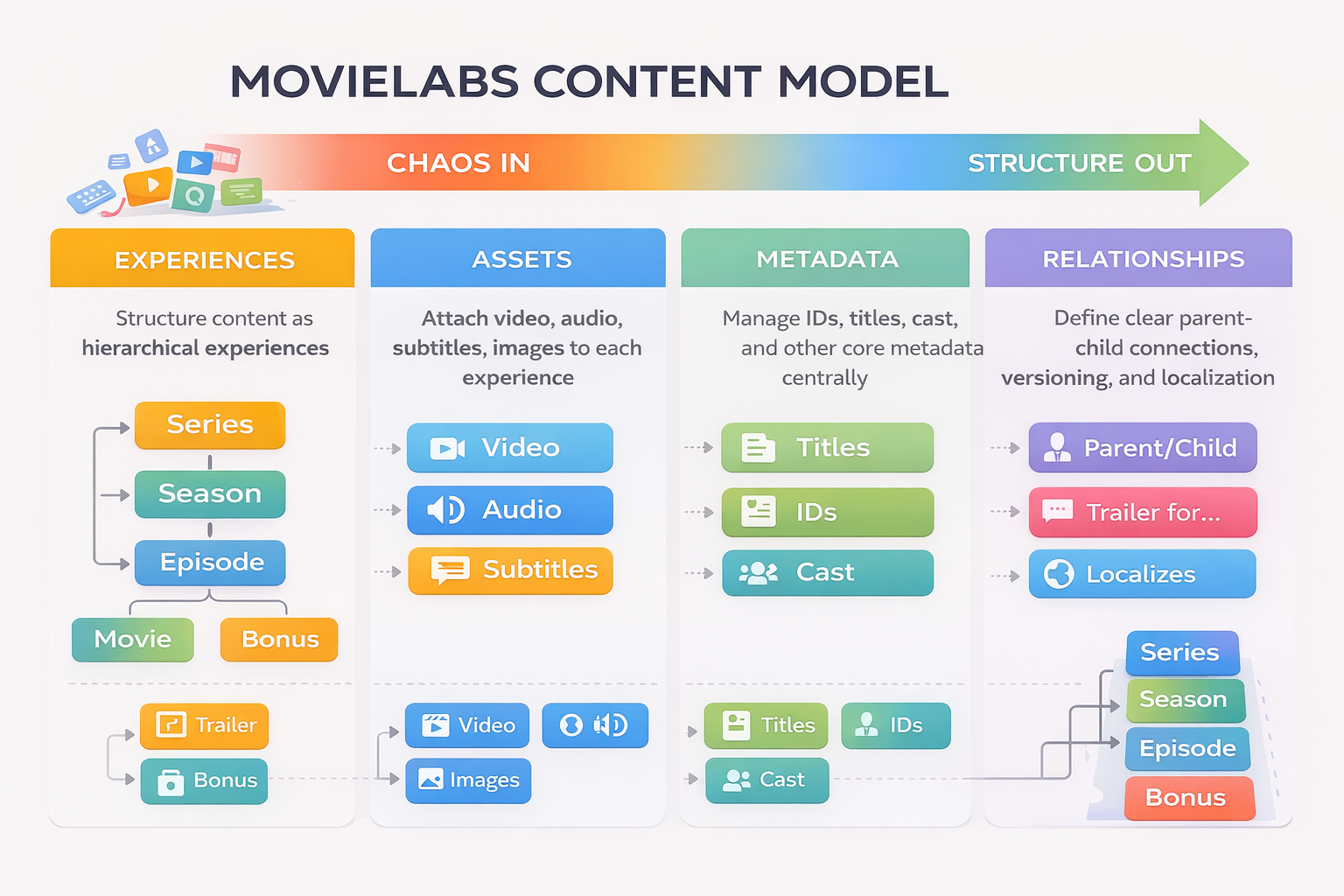
1. Scope and intent
This document describes a normative interpretation of metadata architecture based on the MovieLabs Experience Model, focused on structural correctness, interoperability, and operational scalability.
Its purpose is not to redefine the MovieLabs standard, but to clarify how metadata is expected to behave within systems that adopt the Experience-based content model.
This perspective is intended for system architects, technical leads, and platform integrators.
2. Experiences as primary metadata boundaries
In the MovieLabs model, an Experience is the primary logical unit of content.
Metadata is always scoped to an Experience.
This principle establishes a clear and enforceable boundary:
- Metadata belongs to an Experience
- Metadata does not belong to files
- Metadata does not belong to deliveries
As a result, every Experience defines its own metadata context, regardless of its relationship to other Experiences.
This applies uniformly to:
3. Explicit relationships, implicit isolation
Experiences may be related through well-defined semantic relationships, including but not limited to:
- Parent-child relationships
- Promotional relationships
- Supplemental relationships
However, relationships do not imply metadata sharing.
Any reuse, inheritance, or contextual reference across Experiences must be:
- Explicit
- Intentional
- Traceable
This prevents unintended coupling and preserves Experience autonomy.
4. Separation of concerns
The MovieLabs model enforces a strict separation between three orthogonal concerns:
None of these layers is allowed to subsume the responsibilities of the others.
- Media assets are associated with Experiences but do not define them.
- Metadata informs Experiences but does not encode structure.
- Structure governs relationships but does not contain assets.
This separation is foundational to interoperability.
5. Metadata as a first-class architectural entity
Metadata in the MovieLabs model is not auxiliary.
It is:
Metadata must be treated as a first-class entity within system architectures, capable of evolving without forcing media reprocessing or delivery restructuring.
This principle enables:
- Partial updates
- Incremental redelivery
- Controlled corrections
- Parallel workflows
6. Identifiers and addressability
Each Experience is identified through stable identifiers.
Identifiers serve as:
- The canonical reference across systems
- The anchor for metadata association
- The bridge to external platform identifiers
Identifiers must remain stable across:
- Asset replacements
- Metadata revisions
- Platform mappings
7. Controlled inheritance and metadata propagation
While metadata is scoped to individual Experiences, the model allows controlled propagation through defined relationships.
Propagation rules must be:
- Deterministic
- Explicit
- Overridable
Typical use cases include:
- Series-level metadata referenced by Seasons
- Season-level metadata contextualizing Episodes
- Territory or language-specific overrides
Implicit inheritance is explicitly discouraged.
All propagation must be observable and reversible.
8. Versioning and localization
The decoupling of metadata from assets enables metadata-driven handling of:
- Editorial versions
- Language variants
- Regional adaptations
Localization does not require duplication of Experience structures.
Instead, metadata variants coexist within a single Experience framework, preserving identity while allowing differentiation.
This approach supports global distribution without structural fragmentation.
9. System architecture implications
Systems adopting the MovieLabs metadata model are expected to:
- Treat Experiences as authoritative entities
- Persist metadata independently from assets
- Support identifier-based integration
- Enable partial updates and selective redelivery
- Maintain clear ownership and lifecycle boundaries
Architectures that conflate files, deliveries, and metadata violate the core assumptions of the model and introduce avoidable operational risk.
10. Conclusion
The MovieLabs Experience Model defines metadata not as descriptive decoration, but as structural infrastructure.
When implemented correctly, metadata becomes:
This is essential for modern content ecosystems where complexity, not volume, is the primary challenge.